



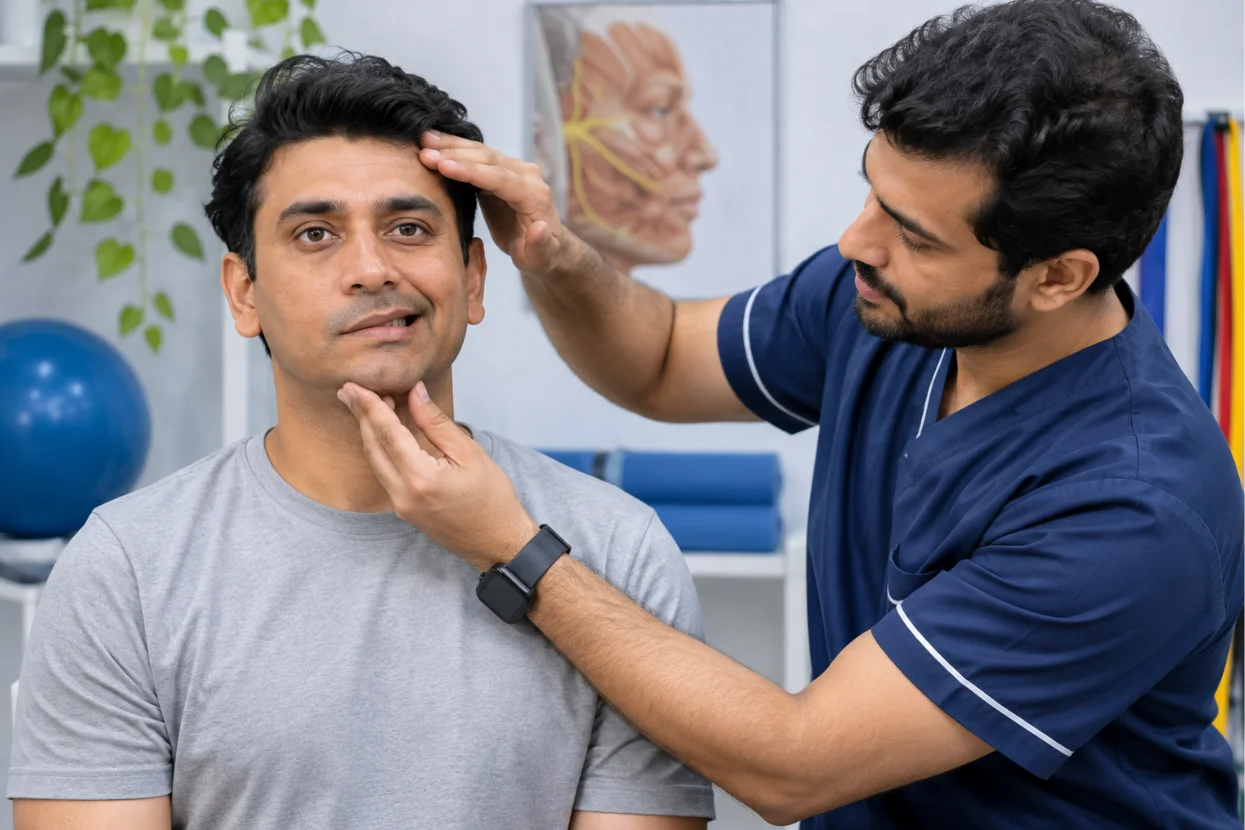
Bell’s palsy physiotherapy in Mira Road at Dr. Vigil’s Advanced Physiotherapy supports recovery when one side of your face suddenly feels weak or droops. If you or your child has a drooping mouth, a weak smile or trouble closing one eye, and a doctor has confirmed Bell’s palsy, our physiotherapists check how the face moves, teach safe facial exercises and guide daily care at our clinics in Mira Road and Mira Bhayandar.
Most people with Bell’s palsy get better, but the weeks of weakness can be worrying. This page is part of our neuro rehabilitation care and explains what physiotherapy can and cannot do.
Important: a drooping face can also be a sign of stroke. If you have arm weakness, slurred speech or confusion, call 112 or your local emergency number now. For any sudden facial droop, see a doctor the same day before starting physiotherapy.
What is Bell's palsy?
Bell’s palsy, also called facial nerve palsy, is a temporary weakness of the muscles on one side of the face. The cause is often unknown, but it is linked to swelling of the facial nerve. The NHS lists a drooping eyelid or mouth, drooling, a dry or watering eye and trouble closing the eye as common signs. It usually appears over a few days, and treatment works best when it starts within 72 hours.
How Bell's palsy physiotherapy helps
Medicines such as steroids are prescribed by your doctor. Physiotherapy works alongside that care, and it can support you in these ways:
- Keeping muscles active: gentle movement so the face does not stiffen.
- Easing tightness: relaxation and soft-tissue work for tight cheek and jaw muscles.
- Facial muscle re-education: slow, controlled exercises in front of a mirror.
- Reducing synkinesis: unwanted linked movements, for example the eye closing when you smile.
- Home care: a short routine and eye and skin care tips.
Bell's palsy recovery: what happens and when
| Stage | What you may notice | Focus of care |
|---|---|---|
| First days to weeks | Weakness, a drooping face, dry eye | Doctor’s medicines, eye protection, gentle movement |
| Recovery phase | Movement slowly returns | Guided facial exercises and relaxation |
| Later stage | Tightness or unwanted movements in some people | Controlled exercises and regular reviews |
The NHS says symptoms usually improve within 6 months, although some people take longer. A few have lasting weakness, which is why steady follow-up matters.
Facial exercises we may teach
Your physiotherapist picks exercises that suit your stage. Typical ones include:
- Gently raising both eyebrows
- Closing the eyes softly without squeezing
- Wrinkling the nose
- A small closed-lip smile
- Puffing the cheeks and pursing the lips
Do each slowly in front of a mirror, a few times, several times a day. Stop and tell us if you feel pain. Do not force big movements, since this can strengthen the wrong muscles.
Eye and daily care
If your eye does not close, it can dry out and become injured. Your doctor may suggest eye drops, ointment or taping the eye at night. We remind you to blink often, protect the eye outdoors and eat on the stronger side while you recover.
Our Bell's palsy physiotherapy in Mira Road: how it works
- Assessment: we check your face, eye closure, speech, chewing and your doctor’s notes.
- Personal plan: a stage-based exercise plan with clear dos and don’ts.
- Sessions and home routine: supervised practice plus short exercises you do daily.
- Reviews: we track progress and adjust, or advise you to see your doctor or an ENT or eye specialist if needed.
If you cannot travel, ask about home visit physiotherapy.
See a doctor urgently if
- Facial droop comes with arm weakness, slurred speech or confusion
- You have severe headache, ear pain with a rash, or hearing loss
- Your eye is painful, red or your vision changes
- There is no improvement after about 3 weeks
Related neuro physiotherapy
If your facial droop is linked to a stroke, see our stroke physiotherapy and paralysis physiotherapy pages. You can also read how physiotherapy helps Bell’s palsy recover in our blog, or visit our main physiotherapy in Mira Road page for other conditions.
Why choose Dr. Vigil's for Bell's palsy physiotherapy?
- Safety first: we ask about stroke signs and send you to a doctor when needed.
- Gentle, stage-based care: no forced exercises.
- Honest advice: no cure claims and no fixed timeline.
- Two clinics, 7 days a week: Mira Road and Mira Bhayandar.
Bell's palsy physiotherapy in Mira Road, Mira Bhayandar and nearby areas
We see patients at two clinics: Mira Road (Shanti Nagar, Sector 9) and Mira Bhayandar (Beverly Park, near Cinemax Road), open 7 days a week. We serve Mira Road, Bhayandar, Kashimira, Naya Nagar, Poonam Vihar and nearby areas.
Book Your Bell's Palsy Assessment
Start with an assessment. We will check your face, explain what is realistic and teach you the first exercises. Call Mira Road on +91 88799 89583 or Mira Bhayandar on +91 86551 88896.
Bell's Palsy Physiotherapy FAQs
Most people with Bell’s palsy recover on their own. Physiotherapy aims to support that recovery by keeping the facial muscles active, easing tightness and reducing unwanted movements. We never promise a fixed result.
The NHS says symptoms usually improve within 6 months, though some people take longer and a few have lasting weakness. Seeing a doctor early gives the best chance.
Ask your doctor first. We usually begin with gentle movements and eye care, and add more as the face starts to move. Exercises should never be forced or painful.
No, but both can droop one side of the face. If you also have arm weakness or slurred speech, call 112 or your local emergency number at once. Always get sudden facial drooping checked by a doctor the same day.
If the eye does not close fully it can dry out. Your doctor may advise eye drops, ointment or taping the eye at night. Follow that advice and tell us about any eye pain or redness.
The NHS says it rarely comes back, sometimes years later. Tell your doctor if you notice facial weakness again.
It depends on how weak your face is and how fast it improves. We plan after your assessment, teach you short exercises to do at home, and review progress regularly.
At Dr. Vigil’s Advanced Physiotherapy: Mira Road (Shanti Nagar, Sector 9), call +91 88799 89583, or Mira Bhayandar (Beverly Park, near Cinemax Road), call +91 86551 88896. Both clinics are open 7 days a week.